Saturday, May 29, 2010

"Seven Pounds": I Told You So!

Friday night, I watched "Seven Pounds" (Amazon and IMDb), starring Will Smith. This blog usually isn't a venue for film reviews, but let me quickly say:

(1) The film is 2 hours and 3 minutes long.
(2) My rating after seeing the first 1 hour and 55 minutes would have been 1 or 2 stars.
(3) My rating after seeing the ending is 5 stars.

Once again, I'm glad that I didn't follow Tyler Cowen's advice to give up on the movie too soon, as I discussed a few days ago.

Oddly, the movie explores the same question I wrote about here a few months ago. However, if you're interested in the movie, I strongly encourage you to see it first before reading too much about it online or clicking this link. But the link is here.

Friday, May 28, 2010

Grocery Store Waste Is Good

CC photo from Steve Hopson on Flickr.

Farmers, restaurants and supermarkets throw away millions of tons of edible food each year at a time when a growing number of Californians struggle to put food on the table.

State studies have found that more than six million tons of food products are dumped annually, enough to fill the Staples Center in Los Angeles 35 times over. Food is the largest single source of waste in California, making up 15.5 percent of the Golden State’s waste stream, according to the California Integrated Waste Management Board.
The above figures come from a partisan source, but no one is disputing the fact that grocery stores throw away a lot of expired food.

But is the waste bad? How could stores be set up to never waste perishable foods?

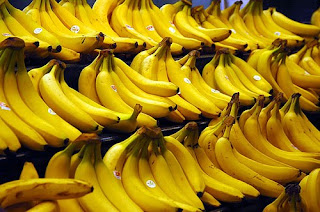
If stores and farmers could perfectly predict demand from week to week far ahead of time, there would be no waste. One week, customers at a given store would want 213 bunches of bananas, and that store would have stocked exactly 213. Obviously, this is not realistic. And even with omniscient grocery stores, consumers would still do a fair bit of throwing away themselves.

Another way would be to limit supply to the bare minimum. Suppose that demand for bananas at a given grocery store fluctuated between 120 and 300 bunches of bananas each week. To never throw away a rotten banana, the store would stock only 120 bunches each week.

If only one store in an area did this, the store would forgo many profitable sales, as its banana-spurned customers shopped elsewhere. If all stores in the area did this, the price of bananas would skyrocket. In either case, farmers and stores would have every incentive to increase production and therefore make more money. Depending on the underlying distribution of weekly banana demand, perhaps our hypothetical store should stock 250 bunches a week. Sometimes demand will fall short and bananas will go bad, but the strategy will be more profitable and consumers will be better off.

As it is now, the grocery store can change prices to help equate supply and demand. If the store has a batch of bananas about to expire, suddenly there's a sale on bananas. However, bananas are already extremely cheap, so customers are only sensitive to price changes up to a point. Eventually, it's cheaper to throw bananas away than to sell them for a penny (or even for negative prices; i.e., paying customers to take them). And there's nothing wrong with that, because the store tolerates a few rotten bananas in some weeks for higher profits in other weeks.

Thursday, May 27, 2010

Domestic Beer Means Cheap Beer

Sam Adams is actually brewed in America, despite its decent taste.

I got a chuckle from a recent blog post written by Washington Post copy chief Bill Walsh. Walsh writes that Samuel Adams is often mistakenly listed on menus as "imported," because "domestic" has become such a synonym for "cheap" and "inferior" when it comes to beer.

Does this perception prove that American goods are inherently shoddy? Or that our status as a world leader is in jeopardy?

No. It's no surprise that the only foreign beers that get widely sold in the United States are the fancier ones.

Suppose that there is a German-brewed equivalent of Bud Light (I'll call it GBL, for German Bud Light). Just like GBL's American counterpart, in the trade-off between taste and price, the pendulum has swung almost all the way in favor of the latter. There's certainly a large market for bottom-of-the-line beer, but GBL cannot compete with BL in the United States because GBL faces higher transportation costs to get the product across the Atlantic.

Now, if labor were significantly cheaper in Germany and if the beer production process required a sufficiently high proportion of labor-to-capital costs, then GBL could save enough money on labor to make up for the transportation costs and thus have a shot at competing with BL. But we don't see such beers very often, suggesting that domestic brewers have an advantage when it comes to supplying the watery ale craved by broke American college students.

On the other hand, perhaps cultural acceptance is a larger hurdle than distribution costs. After Googling around for a while using phrases like "Budweiser in Japan," I found this article, which reports that Budweiser in 2000 had a minuscule share of the Japanese beer market despite hefty advertising.

Wednesday, May 26, 2010

Returns to Scale in Sports

The authors of "The Wages of Wins" point out that basketball talent follows the law of diminishing returns: each additional talented player helps the team less than the player before him. Time and possessions are scarce; there is only one ball, and when one star has it, his teammates, by definition, do not. In their words:

To further illustrate this point, consider a team comprised of the top five players at each position in 1993-94. Such a team would have John Stockton (22.0 wins produced) at point guard, Nick Anderson (13.3 wins produced) at shooting guard, Scottie Pippen (20.4 wins produced) at small forward, Dennis Rodman (29.6 wins produced) at power forward, and Shaquille O’Neal (26.8 wins produced) at center. These players combined to produce 112 wins. If all these players were on the same team, though, their wins produced could not exceed the length of the regular season, or 82 victories. Hence, if we put all five players on the same team someone would have to play worse.
If you don't like the abstract concept of wins, here's an easier one: if you take the top 5 scorers in the NBA, who each average around 30 points per game, and put them on the same team, the team won't average 150 points per game. There just aren't enough shots to go around.

Similarly, adding a productive hitter to an already-talented baseball team also will decrease his productivity or that of one of his teammates. This is because top spots in the batting order are limited. Each time someone besides the No. 9 hitter makes his team's last out in a game, he and the players ahead of him end up with one more plate appearance than the players lower in the batting order. Over the course of the season, the No. 1 hitter gets about 140 more plate appearances than the No. 9 hitter. Each spot down the order gets about 15 to 20 fewer plate appearances per year than the spot preceding it (see the data for yourself). If the team's new hitter now bats sixth instead of third, as he did with his previous team, he'll get fewer opportunities to drive in runs.

Starting pitching, on the other hand, has constant returns. One star starter does not detract from another star starter. Both pitch every 5 days and, barring injury, will end up with about the same number of starts.

Tuesday, May 25, 2010

Why No One Besides Tyler Cowen Leaves Movies Early

"Think of all the bad films you've sat through just to get the answer to the nagging question."

So says screenwriter Robert McKee, as quoted in "Made to Stick: Why Some Ideas Survive and Others Die."

One of the professors in my program, Tyler Cowen, is famous for leaving movies early:

"People should be more willing to walk out of movies," he tells anyone who will listen. "Most movies -- they grab you or they don't, and if they don't, just leave. Just go. You have already lost money. Why lose the time?"

If a movie doesn't hook Cowen, he reads a book outside while his wife remains in her seat. Most recent movie they both left: "Greenberg," starring Ben Stiller.
Underlying this behavior, at least how I see it, is the economic maxim of diminishing returns. Basically, for pretty much everything in life, each extra unit is worth less than the one that came before it.

For instance, the first piece of pizza you eat in a sitting is great, while the seventh piece is much less enjoyable. For Tyler, he figures he could stay and watch all 20 scenes of a given movie, but he decides to leave after seeing the first 12 and figures he won't miss much.

But movies usually offer a spike of interest and enjoyment at the end, because the conclusion is so important. Seeing the movie's ending is often worth suffering through the boring middle parts. Even if the ending is predictable, most of us like to see the good guy win or the lovers finally unite.

For example, I definitely sat through some less-than-stellar "24" episodes this season, just to see if Jack Bauer made it out alive and if the sinister Charles Logan got what was coming to him.

Also, I have the unfortunate hobby of following the Los Angeles Dodgers from the East Coast, where most games start at 10 p.m. local time. Contrast how I act if I watch the last six innings of a game versus if I watch the first six innings.

If I begin watching in the fourth inning, I usually just take the current score as given and don't care how we got there. After watching the ninth inning, I feel a sense of completeness, even though I missed a third of the game.

If I begin watching in the first inning and fall asleep sometime during the sixth, I can't help but wonder how the game ended. The morning after, I inevitably have to look up the final score online. I've missed just as much of the game as in the previous example, but the experience is much different.

Maybe the "he reads a book outside while his wife remains in her seat" part is crucial to Cowen's strategy. After all, it's not so bad to miss the end of a movie if you have someone to fill you in.

The iPhone and Avoiding Feature Creep

There's an interesting aside in "Made to Stick: Why Some Ideas Survive and Others Die" about feature creep. The authors parody the design of a typical TV remote: one designer wants to add a button that allows users to toggle between the Gregorian and Julian calendars, a feature that few users would actually want. But because no other designers are willing to put up much of a fight, the button gets incorporated into the final design. Before long, however, the remote is so overdesigned that it becomes difficult to do the basic things it was intended for: namely, changing the channels and adjusting the volume.

The iPhone, and phones like it, could easily have fallen victim to this desire to add features. Yet Apple locked itself in to simple by shipping devices with only two buttons and volume controls. Additionally, the number of apps that come with the phone are minimal, but users can download whatever additional apps they'd like. That way, users can have a versatile device without being bogged down by the niche features they don't want.

For instance, I love my MLB At-Bat, Kindle for iPhone, and RSS reader apps, but many people would see them as a waste of space. It's like we all have our own customized remotes now. One man's calendar toggler is another man's essential feature.

Monday, May 24, 2010

Quarterback Inconsistency Due to Short Seasons?

In "The Wages of Wins," the authors argue that "quarterbacks are like mutual funds," as past performance cannot determine future productivity.

For instance, the authors decided to "grade" each quarterback, based on that quarterback's productivity compared to the rest of the league in each season, to compare how quarterbacks did from year to year. Each quartile received its own letter grade; i.e., the top 20% of quarterbacks in a given year received A's, the next 20% received B's, and so on.

Often, quarterbacks are rather inconsistent, as evidenced by Kerry Collins:
As a rookie in 1995, Collins ranked in the lowest 20%, receiving an F. In 1996 his performance improved and he received a B. The next two seasons, thought, Collins declined, earning an F in both campaigns. Then in 1999 he earned a C, followed by a B in 2000. After declining again, this time to a C, in 2001, Collins earned an A for his efforts in 2002. Unfortunately his success was short-lived, as his performance was worth a D in 2003. In 2004, the final year we examined, Collins earned a C.
The authors conjecture that quarterback performance varies widely because their success is so dependent on on how the other players block, catch, and play defense.

Each NFL season consists of 16 games. I wondered if batters in baseball, whose batting average is thought to be independent of their teammates, would look similarly inconsistent when examined in 16-game chunks.

Someone with more time and inclination could look at a larger sample, but I looked at Tony Gwynn's 1997 season, in which he won the National League batting title with a .372 average (I used data from the ever-useful Baseball-Reference). That year, Gwynn played 149 games. The below table summarizes Gwynn's performance in the first 144 games, divided into nine 16-game periods.


PeriodAt-batsHitsAveragePercent change
167270.403N/A
263210.333-17.3%
359260.44132.2%
468280.412-6.6%
566260.394-4.3%
667240.358-9.1%
759190.322-10.1%
862220.35510.2%
962190.306-13.6%

Gwynn's lowest period average is .306, still far above the league average (historically around .260). But if he were judged like NFL quarterbacks are, we'd wonder why Gwynn had such a huge drop-off from period 1 to period 2 (equivalent to comparing one season against another in the NFL) before making a huge rebound in period 3. The latter part of the sample, though, doesn't much look like a mutual fund, as the deviations from one "season" to the next aren't very large.

Whether other batters are more or less streaky than Gwynn in '97 remains to be seen.