Economists have modeled education as serving no purpose besides providing graduates a credible signal of their intellectual ability. Some employers have trouble assessing the quality of potential workers, but at least they can deduce something about the candidates based on their ability to get into and graduate from top schools, even if academic success is not perfectly correlated with workplace success. It doesn't matter what the students actually learned, as long as they had the follow-through to graduate. The most famous paper on this topic is Michael Spence's "Job Market Signaling," published in 1973.
Another function of education is accountability. As one professor pointed out to our class last year, we could have all found the syllabus online and read all of the course's books ourselves, so what's the point of doing it in a classroom setting? By enrolling in school (especially if you're paying your own way), you're setting up a situation with bad outcomes if you don't succeed. Whenever you hit a rough patch in the material, these consequences motive you to get through it, whereas otherwise you might have given up, if you were just learning on your own. And if we concede that being around a teacher and fellow students really does help you learn, this increasing your chances of success ever further.
I recently started taking a course in linear algebra (not at George Mason). The professor does nothing more than walk us through the textbook, page by page and sometimes word for word. He has other annoying habits, such as writing whole paragraphs on the white board or telling us about how he keeps getting fired. My classmates complain about his teaching methods, and he's definitely one of the worst teachers I've ever had. But if nothing else, I'm going through the textbook to answer his homework questions (or rather, the textbook author's homework questions), something I would have had a hard time motivating myself to do if I had just bought the textbook and put it on my coffee table, promising myself that I would get around to studying it someday.
Friday, April 30, 2010


Tuesday, April 27, 2010
Sports Standings and Sample Sizes
Are MLB standings more "accurate" than NFL standings, because of the larger sample size?
In the NFL, 16 games are enough to round out the season and decide which teams make the playoffs. Luck may play a factor in deciding a game or two, but rarely do people argue that horrible teams routinely finish with fluke records like 10-6.
In baseball, the standings after 16 games are pretty meaningless (here's what they were this year). This year, the Dodgers and Red Sox--both perennial powers--had losing records after 16 games, while the abysmal Padres shared the best record in the National League. Of course, 16 games only make up 10% of the baseball season, so it's no wonder why people often disregard statistics from the first month or so of the season (when there are also several players hitting above .400 and several pitchers with ERAs of zero).
Football is a brutal sport, impossible to play at the NFL level every day. But if there were some way to have the teams play 162 games instead of 16, would the final standings differ much from what they are now?
The variance is winning percentages are much wider in the NFL. In 2009, the best baseball team won 63.6% of the time, and the worst won 36.4% (standings). In the NFL, the analogous figures were 87.5% and 6.2% (standings). With enough repetition, would the St. Louis Rams eventually have a winning percentage around 35%? Or does football have inherently less parity than baseball? Or maybe football is played differently because there are so few games; i.e., if the baseball season were only 16 games, I doubt we'd see five-man starting rotations.
For those unfamiliar with statistics, see this page for more on sample sizes. The basic idea is making inferences about the underlying "true" quality of a league's teams. The more games, the better idea we should have about this underlying quality. This requires the rather dubious assumption that the team's quality hasn't fundamentally changed over the course of the season, such as a key player getting injured or a rookie blossoming into a star.
In the NFL, 16 games are enough to round out the season and decide which teams make the playoffs. Luck may play a factor in deciding a game or two, but rarely do people argue that horrible teams routinely finish with fluke records like 10-6.
In baseball, the standings after 16 games are pretty meaningless (here's what they were this year). This year, the Dodgers and Red Sox--both perennial powers--had losing records after 16 games, while the abysmal Padres shared the best record in the National League. Of course, 16 games only make up 10% of the baseball season, so it's no wonder why people often disregard statistics from the first month or so of the season (when there are also several players hitting above .400 and several pitchers with ERAs of zero).
Football is a brutal sport, impossible to play at the NFL level every day. But if there were some way to have the teams play 162 games instead of 16, would the final standings differ much from what they are now?
The variance is winning percentages are much wider in the NFL. In 2009, the best baseball team won 63.6% of the time, and the worst won 36.4% (standings). In the NFL, the analogous figures were 87.5% and 6.2% (standings). With enough repetition, would the St. Louis Rams eventually have a winning percentage around 35%? Or does football have inherently less parity than baseball? Or maybe football is played differently because there are so few games; i.e., if the baseball season were only 16 games, I doubt we'd see five-man starting rotations.
For those unfamiliar with statistics, see this page for more on sample sizes. The basic idea is making inferences about the underlying "true" quality of a league's teams. The more games, the better idea we should have about this underlying quality. This requires the rather dubious assumption that the team's quality hasn't fundamentally changed over the course of the season, such as a key player getting injured or a rookie blossoming into a star.
Monday, April 26, 2010
Teachers' Appreciation Day Saves Taxpayers Money (Probably)
A Twitter colleague of mine opines about why she doesn't like Teachers' Appreciation Day:
Teaching has all sorts of nonmonetary benefits, such as the satisfaction of influencing young lives, the favorable work schedule (summers off for most), and the various forms of recognition, including Teachers' Appreciation Day.
Because of nonmonetary benefits, fun jobs pay less, all else equal. Many people would happily choose teaching elementary school at $35,000 a year over a working a boring job at $50,000 a year.
If we cut some of these nonmonetary benefits, we'd have to increase teacher salaries, in order to keep the existing pool of teachers away from alternative professions. Teachers probably value the recognition more than it "costs" us to provide it, so paying teachers in recognition instead of cash is probably a good deal for taxpayers.
As another example: imagine how much more we would have to pay teenagers to become soldiers if there were no parades, standing ovations at public events, or other acts of respect.
And, just on a personal note, I think I’d rather be the person who I would have been in the absence of about 1/3 of the teachers I had in K-12. Surprisingly many of them were not only incompetent, but petty, power-hungry, and even vindictive. I remain angry and bitter about those damaging years, and it’s part of why I’m so interested in education now (Maybe I’ll write a whole post on my anger and bitterness another time). But, because it was a wealthy area, most of the students did just fine academically – despite these bad teachers, not because of them. And, every year, the parents were coughing up expensive gifts and gift certificates for the poor, underappreciated teachers. I reckon that many of the teachers who truly deserve some extra appreciation – those who work with severely underprivileged students, those whose schools are unsafe, those who don’t make a decent living – are those who are, sadly, the least likely to receive it, holiday or not.I agree that it feels gross to systematically honor certain people, especially entire professions. But maybe society is better off because of it?
Teaching has all sorts of nonmonetary benefits, such as the satisfaction of influencing young lives, the favorable work schedule (summers off for most), and the various forms of recognition, including Teachers' Appreciation Day.
Because of nonmonetary benefits, fun jobs pay less, all else equal. Many people would happily choose teaching elementary school at $35,000 a year over a working a boring job at $50,000 a year.
If we cut some of these nonmonetary benefits, we'd have to increase teacher salaries, in order to keep the existing pool of teachers away from alternative professions. Teachers probably value the recognition more than it "costs" us to provide it, so paying teachers in recognition instead of cash is probably a good deal for taxpayers.
As another example: imagine how much more we would have to pay teenagers to become soldiers if there were no parades, standing ovations at public events, or other acts of respect.
Help Amazon Sell Kindle Books and Earn $0!

Many Web sites, including this one, earn commissions when they refer customers to Amazon.com who end up purchasing items. Last week, I noticed that I earned a 0% referral fee for helping Amazon sell a Kindle book, netting the company about $9. I wrote to Amazon, and here's the response I got back:
Hello,Kindle books are a loss leader (here's a good discussion from Newsweek). In other words, Amazon loses money on each Kindle book it sells in hopes of getting people to buy Kindles at a hefty markup. Maybe the economics of ebooks will change someday, but for now, it's understandable that Amazon doesn't want its partners to push sales of Kindle books to people who already own Kindles, hence the 0% referral fee.
At this time, Kindle Books are excluded as Qualifying Products. While we don't pay advertising fees on Kindle Books, we continue to pay a 10% advertising fee on all qualifying Kindle reader sales and Kindle magazine and blog subscriptions referred to us.
We appreciate your understanding.
However, Amazon partners can't control whether the customer will buy the Kindle or the print version. If 50% of the people you refer end up buying the Kindle version, then the nominal 4% referral fee you earn on book sales effectively becomes 2%. (This is ignoring some pricing differences and the fact that the existence of the Kindle increases overall demand for books, securing some sales that otherwise wouldn't have been made.) This decreases the expected returns to hawking Amazon's wares, which should in turn reduce the number of referrals for Amazon books, both print and Kindle versions.
UPDATE 5/4: Apparently Amazon has changed course.
Sunday, April 25, 2010
Could Any NFL Player Be Had in Exchange for Draft Picks?
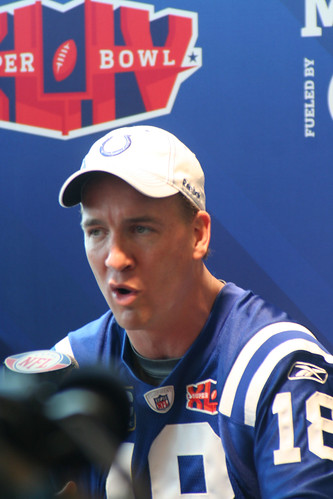
In the NFL, teams can trade players, cash, and draft picks. The value of future draft picks depends on many things (more on this later), but these picks unambiguously have positive value.
Because of this, is no NFL player untouchable, as his value can be exchanged for draft picks? For instance, say that we could compute a value of 100 points (on some scale) for Peyton Manning. In theory, a team could send 100 points worth of draft picks (maybe that's two picks next year, or maybe that's three years' worth of picks) to the Colts in exchange for Manning, and both sides would be happy.
The value of a draft pick many years down the road has a wide variance. The trading team's record the year before (which determines its draft position), the receiving team's needs, and the overall strength of the draft class are all unknown. Additionally, draft picks in the far future are worth less than draft picks today, because of greater uncertainties and the pressure to succeed today. But presumably teams could discount the value of future picks accordingly and be able to trade gobs of picks for today's star players.
Perhaps star players usually stay put because of the endowment effect. In other words, people put higher value on things they already have. A good example is something like tickets to a big game. If you already have the tickets, it might take $200 for you to part with them, but if you don't have tickets, you might only be willing to pay $100 to purchase them. Your valuation of the tickets is inconsistent, as it depends on whether you already have them. In this case, perhaps the Colts value Manning at 200 points while the rest of the league only values him at 100 points.
Additionally, general managers have an incentive to win now. Maybe it would be smart to trade Manning for three years' worth of picks, but the Colts would immediately suffer in the short term, and the GM might be fired long before the team sees the value of these future picks come to fruition.
Thursday, April 22, 2010
Asinine TV Dinner Instructions

CAREFULLY remove film from top as PRODUCT WILL BE HOT.This is pretty standard, but it's still amusingly over-the-top. Anyone with the least bit of life experience knows that items placed in the microwave tend to heat up. (Also, why does CAREFULLY deserve to be in bold, but not PRODUCT WILL BE HOT?)
CHECK that product is cooked thoroughly. Internal temperature needs to reach 165 degrees F as measured by a food thermometer in several spots.Wow. Some people are too lazy to cook, so they make TV dinners. Other people routinely check the temperature of their meals using a food thermometer in several spots. It's doubtful that there's any overlap between these two groups.
These extremely cautious directions are no doubt a result of the 1994 McDonald's coffee lawsuit. Now, consumers have no one to blame but themselves. You can almost sense the committee of lawyers that oversaw the process. Why else would the directions always refer to your food as "product" instead of "food" or "meal"?
The most litigious among us are ruining it for the rest. There are tradeoffs between how useful and how legally thorough a set of directions can be. For the sake of an extremely small group of people, companies now have to err on the side of caution, sacrificing brevity and clarity for the majority of their customers.
Wednesday, April 21, 2010
Invest in Stocks or Housing?
This is an oldie but goodie, pointed out by many other economists.
Which investment performs better over the long run, housing or the stock market?
Without even looking at the data, the answer has to be the stock market. That's because a home provides you a place to live, or a place that you can rent out to other people, earning rental income.
Stock ownership has no such auxiliary benefits. If the average annual rate of return for housing was, say, 5%, then the average return for stock ownership must be higher, to compensate for the fact that it doesn't directly provide you warmth and shelter. If the average return to stocks were lower decade after decade, there would be no point in investing in them.
(Of course, sometimes the whole thing gets blown out of whack, as it has the past few years. But over the long haul, the above holds true.)
Which investment performs better over the long run, housing or the stock market?
Without even looking at the data, the answer has to be the stock market. That's because a home provides you a place to live, or a place that you can rent out to other people, earning rental income.
Stock ownership has no such auxiliary benefits. If the average annual rate of return for housing was, say, 5%, then the average return for stock ownership must be higher, to compensate for the fact that it doesn't directly provide you warmth and shelter. If the average return to stocks were lower decade after decade, there would be no point in investing in them.
(Of course, sometimes the whole thing gets blown out of whack, as it has the past few years. But over the long haul, the above holds true.)
Subscribe to:
Posts (Atom)
-
I just got a targeted phone pitch from the Washington Nationals season ticket office. So targeted, in fact, that it reminded me of the re...
-
There's been renewed speculation that a new version of the iPhone is coming out this summer and possibly a Verizon version as early as ...
-
I can apply for loans, communicate with doctors, and do any number of other sensitive things online, but to vote I must go somewhere (which ...
